
The Relationship Audit: The Elul Guide to Repairing Relationships Before Rosh Hashanah - PART ONE
Written by Yitzchak Zeitler
"For if you forgive others for their failings, your Heavenly Father will forgive yours." While this sentiment appears in other religious traditions, Judaism has long taught a parallel and profound truth: the path back to HaShem runs directly through the people around us.
As the month of Elul dawns, shofar blasts pierce the quiet of each morning, awakening hearts that may have become dulled by routine. We instinctively begin looking inward. We examine our prayers, our Torah study, our mitzvah observance, and our spiritual aspirations. Yet Judaism insists that there is another examination—perhaps an even more challenging one—that must accompany our personal introspection.
Before we ask whether we are at peace with HaShem, we must ask whether we are at peace with His children.
Elul is not merely a season of private repentance. It is a season of repairing relationships. Before we stand before the King on Rosh Hashanah, we are invited to conduct what might be called a relationship audit—an honest, courageous assessment of the people in our lives, the wounds we've caused, the grudges we've carried, and the bridges still waiting to be rebuilt.
Why Relationships Matter So Much During Elul
The Mishnah teaches:
"Yom Kippur atones for sins between a person and HaShem, but for sins between one person and another, Yom Kippur does not atone until one appeases his fellow."
(Mishnah Yoma 8:9)
This astonishing statement reshapes our understanding of repentance. We sometimes imagine teshuvah as a deeply private experience: prayer, confession, charity, fasting, and personal resolve. But Judaism teaches that Heaven itself will not erase interpersonal wrongdoing until we first address it here on earth.
The Rambam codifies this principle in Hilchos Teshuvah 2:9, writing that one who injures another—whether physically, financially, or emotionally—is obligated to seek forgiveness directly from the injured party. Even a sincere confession before HaShem is insufficient if reconciliation has not first been attempted.
This is a remarkable theological principle.
Our relationship with HaShem cannot be fully repaired while our relationships with His creations remain fractured.
Elul: The Month of Return
The very name Elul has become associated with one of Judaism's most beloved acronyms:
Ani leDodi veDodi li
"I am my Beloved's, and my Beloved is mine."
(Shir HaShirim 6:3)
Many commentators famously note that the first letters of these words spell Elul, teaching that this month is uniquely suited for restoring closeness between ourselves and Hashem.
Yet the verse itself is about THE main relationship.
Love.
Connection.
Mutual closeness.
It reminds us that Judaism never envisions spirituality as isolation. The ability to love HaShem is intertwined with the ability to love people created in His image. The Torah itself summarizes the ethical heart of Judaism with the famous command:
V’ahavta L’reiacha Kamocha
"You shall love your fellow as yourself."
(Vayikra 19:18)
Rabbi Akiva famously declared:
"This is an all-embracing principle of the Torah."
(Sifra, Kedoshim 4:12)
Not merely one commandment among many—but a foundational principle upon which so much of Torah life rests.
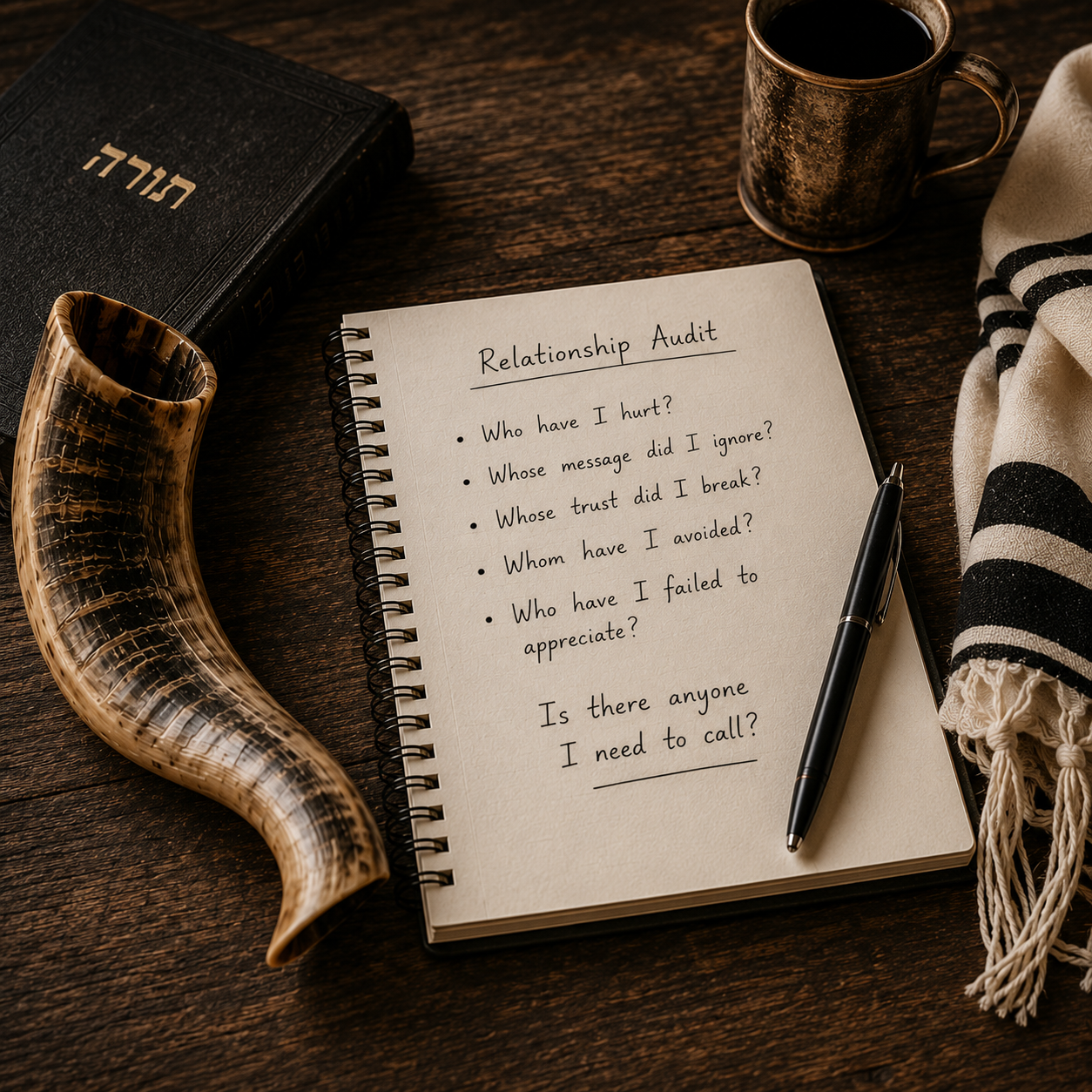
The First Question: Is There Anyone I Need to Call?
Every financial audit begins with identifying outstanding debts. A relationship audit begins the same way.
Who have I hurt?
Whose message did I ignore?
Whose trust did I break?
Whom have I avoided because the conversation feels uncomfortable?
Rabbeinu Yonah, in Shaarei Teshuvah, repeatedly emphasizes that true repentance requires facing the damage we have caused—not merely regretting it privately. Sometimes the hardest phone call of Elul is also the holiest.
It may not erase years of pain. It may not immediately restore trust. But Judaism never measures success solely by outcomes. It measures whether we made a sincere effort.
The Rambam even teaches that if the offended party refuses forgiveness, the offender should continue trying sincerely—even returning with others to help facilitate reconciliation—before ultimately being released from further obligation after repeated genuine attempts (Hilchos Teshuvah 2:9).
Notice the emphasis:
Not perfection. Effort.
The Hidden Cost of Unresolved Conflict
Shlomo HaMelech writes:
"Hatred stirs up strife, but love covers all faults."
(Mishlei 10:12)
Resentment is expensive. It consumes emotional energy. It narrows perspective. It transforms ordinary interactions into silent battles.
The Mussar masters often compared unresolved anger to carrying a heavy burden that only grows heavier with time. Rabbi Yisrael Salanter, founder of the Mussar Movement, famously emphasized that a person's true spiritual greatness is measured not only by ritual devotion but by refinement of character and sensitivity toward others.
One can pray with extraordinary concentration while simultaneously humiliating family members.
One can learn Torah for hours while speaking harshly to employees.
One can meticulously observe mitzvos while quietly nurturing resentment for decades.
Judaism insists these contradictions deserve attention.
The Audit Begins at Home
It is tempting to think first about distant acquaintances or dramatic conflicts.
Yet Elul invites us to begin much closer.
Our spouses.
Our parents.
Our children.
Our siblings.
Our closest relationships are often where apologies become most overdue.
Familiarity breeds assumptions. We stop saying thank you. We interrupt more than we listen. We correct more than we encourage.
The Gemara observes:
"Rebbe Chelbo says that a person should always be careful regarding the honor of his wife, because blessing is found in one's home only on her account."
(Bava Metzia 59a)
Notice the language.
Not merely kindness.
Honor.
Respect.
The home becomes the first testing ground of our spiritual maturity.
The Chafetz Chaim often noted that speaking gently within one's own household may be among the greatest expressions of Torah observance, precisely because it is hardest where people know us best.
The Relationships We Quietly Neglect
Not every damaged relationship involves conflict. Some simply involve neglect.
There are friends we've meant to call.
Parents we've promised to visit.
Mentors we've forgotten to thank.
Children waiting for uninterrupted attention.
The Pele Yoetz writes that gratitude is among the defining characteristics of an elevated soul. How often do we express appreciation to those who quietly sustain our lives?
Perhaps Elul asks us not only:
"Whom have I hurt?"
But also:
"Whom have I failed to appreciate?"
Some simple remedies include:
A short message.
A handwritten note.
An unexpected visit.
These seemingly small gestures can become profound acts of teshuvah.
Lashon Hara: The Relationship Destroyer
No relationship audit can ignore the power of speech. Shlomo HaMelech compares life and death themselves to the tongue:
"Death and life are in the power of the tongue."
(Mishlei 18:21)
The Chafetz Chaim devoted an entire lifetime to demonstrating that careless speech fractures communities more effectively than almost any other sin.
Rumors.
Sarcasm.
Embarrassment.
Online criticism.
Passive-aggressive comments.
These may seem fleeting, yet words often outlive the moment in which they were spoken.
The Talmud compares publicly embarrassing another person to shedding blood (Bava Metzia 58b).
The face drains of color.
The dignity disappears.
The wound remains.
As we prepare for the Days of Judgment, Elul challenges us to ask uncomfortable questions:
Have my words healed—or harmed?
Do people feel safer after speaking with me?
Would my family describe me as encouraging or critical?
Have I repeated information that was never mine to share?
These questions may be uncomfortable. That is precisely why they matter.

The Courage to Apologize
Modern culture often views apologies as a weakness. Torah views them as a strength.
The Gemara praises those who are:
"Insulted but do not insult in return, who hear themselves disgraced yet do not respond, who act out of love and are joyful in suffering."
(Shabbos 88b)
Such people, says the Gemara, are described by Scripture as:
“And they that love Him are as the sun going forth in its might” (Shoftim 5:31)
Real strength is not winning every argument. Real strength is saying:
"I was wrong."
"I hurt you."
"I didn't realize."
"I'm sorry."
Those four statements have repaired marriages, restored friendships, reunited siblings, and transformed communities. Not every apology will be accepted. Not every relationship can be fully restored. But every sincere apology restores something within the person offering it.
Teshuvah begins long before Heaven forgives us.
It begins when humility replaces ego.