
Parshas Matos-Masei: Why are They Read Together, and Why does Every Journey Matter?
A Unified Look at the Calendar Structure and the Spiritual Map of Parshas Matos–Masei
Written by Yitzchak Zeitler
Each summer, something subtle but striking happens in the Torah reading cycle: two distinct parshiyos—Matos and Masei—are often joined and read as one. At first glance, they feel very different. Matos deals with vows, leadership, war with Midian, and tribal responsibilities. Masei reads like a travel journal of the Jewish people’s 40-year journey through the wilderness.
Yet the pairing is not accidental. It reflects both a technical structure of the Jewish calendar and a profound spiritual message about how journeys define identity.
To understand why they are read together—and why that matters—we need to look at both halachic sources and classical Torah commentary.
Part 1: Why Are Matos and Masei Sometimes Combined?
1. The Structure of the Jewish Calendar
The Torah is divided into 54 parshiyos, designed to be read over the course of a year. However, the Jewish calendar does not always provide exactly 54 Shabbosos available for reading. To satisfy these mathematical guidelines, specific consecutive parshiyos must be combined or separated depending on whether it is a leap year or a regular year.
The halachic system of adjusting parshiyos is codified in the Shulchan Aruch (Orach Chaim 428:4–5), and, although Matos and Masei are not specifically listed here, this specific section lays out the cornerstone rules for anchoring the calendar.
This occurs primarily for practical reasons:
To ensure the Torah is completed annually
To adjust for leap years (when there are extra months)
To align readings between Israel and the Diaspora when calendars differ
2. When and Why Matos–Masei Are Joined
Matos and Masei are typically combined in non-leap years in many communities, when there are fewer Shabbosos available between Pesach and Rosh Hashanah.
When the calendar is “compressed,” certain parshiyos are paired:
Vayakhel–Pekudei
Tazria–Metzora
Acharei–Kedoshim
Behar–Bechukosai
Matos–Masei
The principle is simple: when necessary, shorter parshiyos are joined so the annual reading cycle remains intact.
The Gemara alludes to the flexibility of Torah reading cycles being established for communal order and continuity (see Megillah 29b–31b regarding Torah reading structure and public reading obligations).
3. A Deeper Structural Meaning
While the technical reason is calendar-based, many commentators note that paired parshiyos often share conceptual themes. Matos and Masei, in particular, form a natural bridge:
Matos = vows, discipline, leadership, conflict
Masei = journeys, transitions, reflection, destiny
Together, they form a narrative arc: how a people bound by commitments move through history and geography toward their destination.

Part 2: Matos–Masei as One Continuous Story
Although separated in content, these parshiyos are deeply connected.
Matos: The Power of Speech and Commitment
The opening of Matos centers on the laws of vows (Nedarim), emphasizing the seriousness of spoken commitment. Through the study of the Gemara in Masechtas Nedarim, speech is not only casual, but through oaths and vows and the like, speech has the power to create a binding spiritual reality with often severe consequences.
Even though vows represent the human capacity to elevate ordinary life into holiness through discipline and self-imposed boundaries, they are very serious and even frowned upon because why would one forbid something that was already permitted to them?
The Kli Yakar (Bamdibar 30:3) says the following:
Our Sages (Nedarim 22a) spoke disparagingly of one who vows, saying that one who vows is as if he built a private altar, and one who fulfills such a vow is as if he offered a sacrifice upon it. As a sort of proof for their words, Rashi explained: “It says here this is the matter, and it says regarding sacrifices outside the Temple this is the matter, etc.” And I say, derive from this connection: Just as there it refers to a private altar, so too here it refers to a private altar. The reference to “sacrifices outside the Temple” means offering on a private altar, and this is the matter mentioned here regarding one who makes vows; it’s as if he speaks of bringing an offering on a private altar, because one who vows is similar to one who built a private altar. The reason for this is that the Torah understood the mindset of one who vows, for he prohibits upon himself what the entire world treats as permitted. Presumably, his haughtiness led him to separate himself from the entire congregation and remove himself from the community.
From there, the parsha transitions into:
War against Midian
Allocation of spoils
Requests from Reuven and Gad to settle east of the Jordan
To elaborate regarding the requests of the tribes of Reuven and Gad, they request land outside the main inheritance of Israel. Their request is accepted conditionally, emphasizing responsibility and follow-through.
Matos teaches a foundational principle:
Before entering a new stage in life, a person must clarify commitments.
Freedom without responsibility leads to fragmentation.
Speech, intention, and action must align.
In this way, Matos becomes the “pre-journey discipline” that ensures the journey itself has direction.
A central theme emerges: responsibility and accountability in leadership and speech.
Masei: Mapping the Journey of Life
Parshas Masei begins with a detailed list:
“These are the journeys of the Children of Israel…” (Bamidbar 33:1)
Rashi famously notes:
“Why were these journeys recorded? To make known the acts of kindness of the Omnipresent…” (Rashi, Bamidbar 33:1)
Even in moments of hardship and wandering, Hashem was guiding them with care. Each stop had meaning, even when it felt like confusion.
The Ramban (Bamidbar 33:1) expands this idea:
And the Rabbi [Moshe ben Maimon] (The Rambam) added in the Moreh Nevuchim (III:50) another [explanation as to the] benefit [that we derive] from knowledge [of these stages], saying: “There was a very great necessity in mentioning the [stages of the] journeyings. For [although] the miracles and wonders that were done were [recognized as] true ones by all who saw them, in later times these events would be matters of hearsay, and those who hear about them [then] might deny them altogether.”
The listing of journeys preserves memory of miracles and divine protection throughout the wilderness
What seems like repetition becomes, in fact, a spiritual diary of survival, growth, and divine presence.
Part 3: Why Every Journey Matters
Continuing in the review of Masei, this parsha is not just a travel log. It is a philosophy of life.
1. Life Is Not Defined Only by Destination
The Torah could have summarized the journey in one sentence: “They traveled in the wilderness for 40 years.” Instead, it lists 42 encampments.
The Sforno (Bamidbar 33:1) adds that the purpose of recording these journeys is to praise the Jewish people for their unwavering faith in Hashem. Despite traveling through a barren wilderness where nothing could grow, they followed Him faithfully, and this loyalty is itself part of what earned them the right to inherit the Land of Israel.
This teaches a fundamental principle:
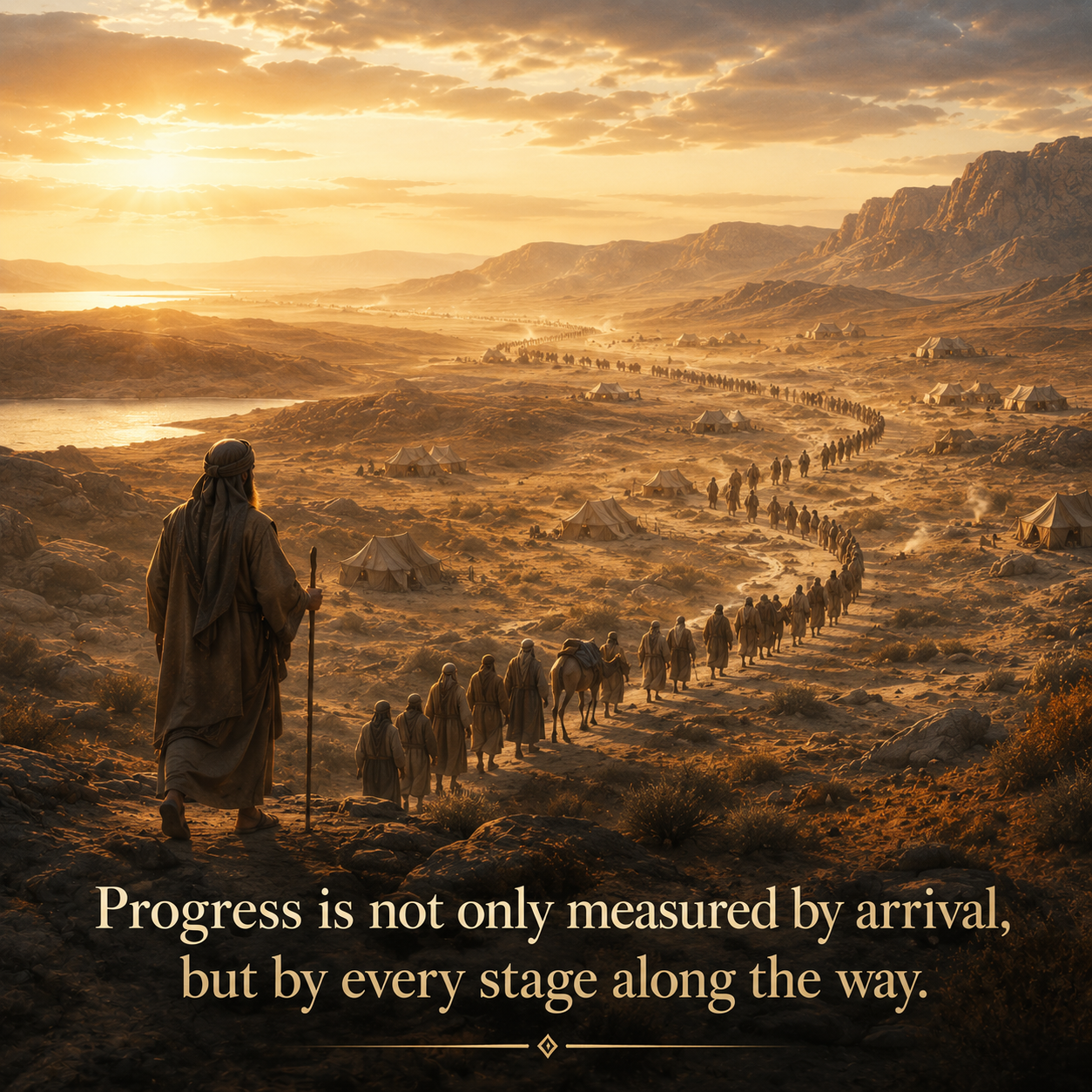
Spiritual significance is not only found in the destination, but also in the faithfulness demonstrated throughout the journey.
2. Even Difficult Stops Have Meaning
Many of the encampments in Masei were places of complaint, failure, or suffering—such as Marah or Kivros Hataavah.
Yet they are still listed.
Rashi’s comment that the journeys demonstrate Hashem’s kindness implies something radical: even the painful stages are part of divine guidance.
This aligns with a broader Torah principle that history is not random. As the prophet Yirmiyahu states:
“I remember the kindness of your youth, the love of your bridal days, your following Me into the wilderness, in a land not sown…” (Yirmiyahu 2:2)
The wilderness itself becomes a place of love and covenant.
Part 4: The Connection Between Matos and Masei
When read together, these parshiyos form a unified message:
Matos: What You Commit To
Matos begins with vows and tribal identity. It defines internal discipline:
Words have power
Commitments shape destiny
Leadership requires responsibility
Masei: Where Those Commitments Take You
Masei shows the external unfolding of those commitments:
A nation travels through uncertainty
Every stage is guided
Even setbacks become part of the plan
Together they teach:
What you commit to in “Matos” determines how you experience your “Masei.”
Part 5: A Unified Spiritual Insight
The pairing of Matos and Masei suggests a profound synthesis:
1. Life Requires Both Stability and Movement
Matos = stability, structure, binding commitments
Masei = movement, change, unfolding experience
Judaism insists both are necessary. A life of pure stability becomes stagnant; a life of pure movement becomes directionless.
2. The Journey Is Not Random
The Torah’s insistence on listing every stop teaches that:
No phase is wasted
No detour is meaningless
Even confusion has a role in divine design
3. Reflection Transforms Experience
As was mentioned in the Rambam, by naming each journey, the Torah transforms wandering into memory, and memory into meaning.
And to reiterate the teaching of the Sforno, remembering the journeys is itself an act of faith in divine providence (Sforno, Bamidbar 33:1).
Conclusion: Reading Matos–Masei as One Message
The reason Matos and Masei are often read together is partly technical—rooted in the structure of the Jewish calendar as described in Shulchan Aruch Orach Chaim 428. But the pairing reveals something far deeper.
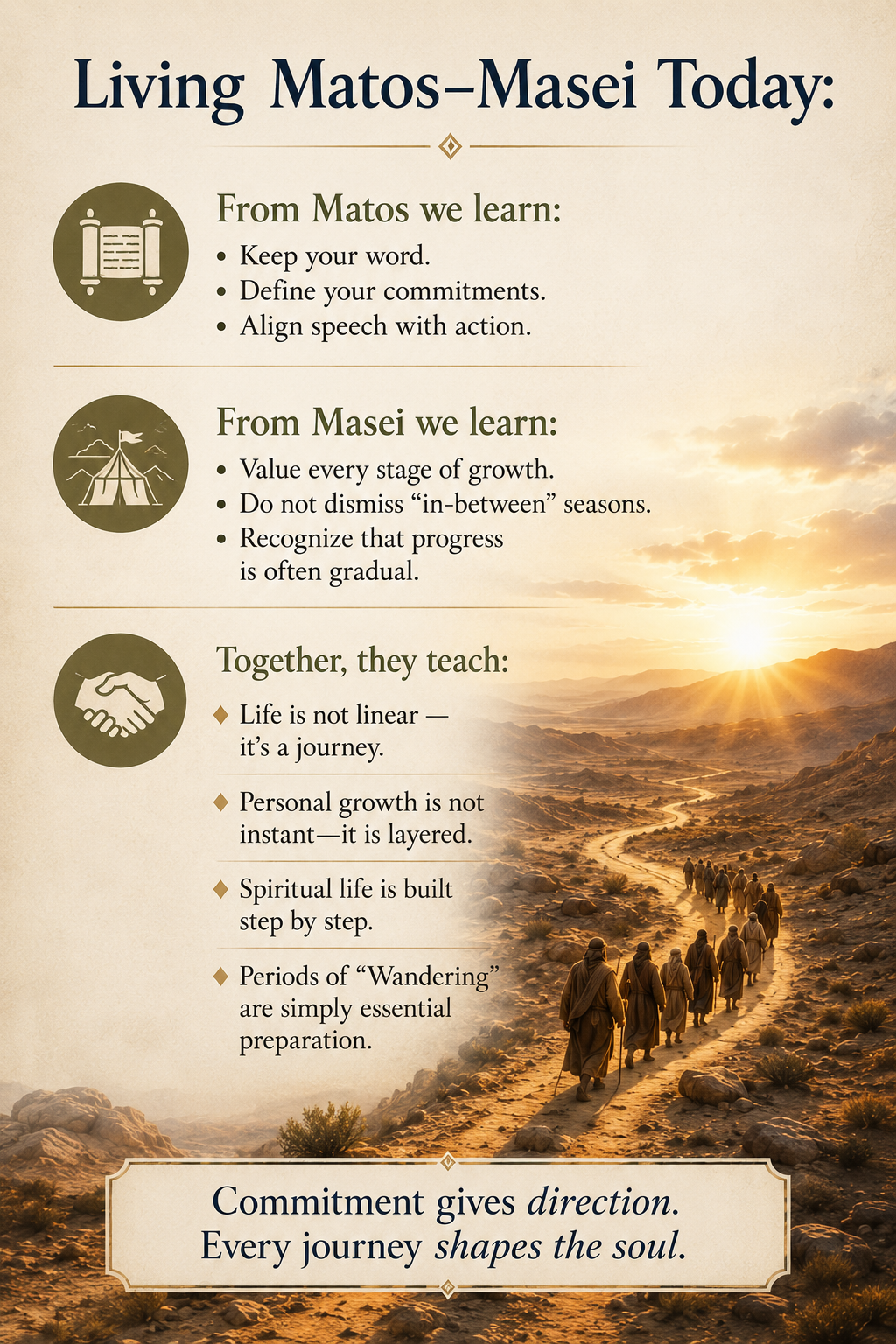
Matos teaches that words, vows, and commitments shape who we are.
Masei teaches that every step of the journey—especially the difficult ones—shapes who we become.
Together, they form a single message:
A life of meaning is built not only on where you arrive, but on what you commit to—and how you travel through every stage along the way.
In that sense, Matos–Masei is not just a calendar pairing. It is a map of Jewish life itself: disciplined beginnings, unpredictable journeys, and ultimately, purposeful direction guided by Hashem through every step.