
Creating Places to Land: The Art and Vision of Blima Nechama Spetner
Written by Claire Zeitler
For years, Blima Nechama Spetner had no intention of selling her art.
She painted because she needed to.
What began as therapeutic journaling gradually evolved into something larger. Paint found its way onto canvases, then onto walls. Her home became a gallery of deeply personal creations, each piece representing a moment, an emotion, or a chapter in her own journey.
Visitors would often stop and stare.
"Do you sell these?" they would ask.
The answer was always the same.
"No."
To Spetner, these weren't products. They weren't inventory. They weren't even artwork in the traditional sense. They were pieces of herself. The idea of selling them felt almost impossible.
"They were like my children," she says.
And so she continued creating, never seriously considering that what she was making might have value beyond her own walls.
Then everything changed.
After more than a decade away from the United States, Spetner returned for a family simcha. Looking for meaningful gifts, she packed several pieces of her artwork to bring to relatives.
While presenting one of the pieces to a family member, a woman nearby noticed the painting and immediately asked where it had come from.
When Spetner explained that she had created it herself, the woman asked if she could buy it.
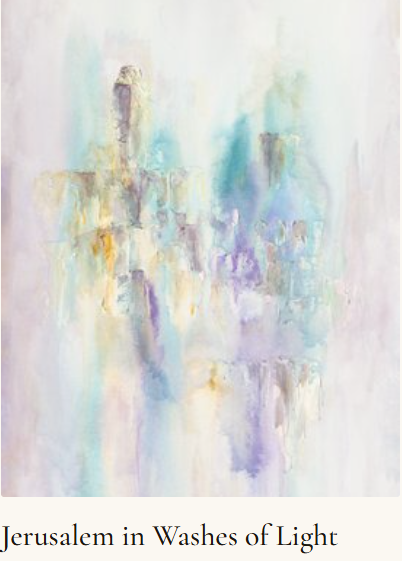
In her mind, Spetner was already calculating what she considered a reasonable price—something modest, almost symbolic. Before she could answer, her sister-in-law stepped in.
"The small one is four hundred dollars," she said. "The large one is six hundred."
Without hesitation, the woman purchased the larger piece.
For Spetner, the moment was transformative.
Years of encouragement from friends and visitors had never quite landed. Yet watching someone immediately recognize value in her work forced her to confront something she had never fully believed herself.
Maybe this gift was meant to be shared.
Around the same time, another profound life experience led her to reevaluate her direction.
After the devastating loss of a full-term baby, Spetner found herself reflecting deeply on purpose, meaning, and what Hashem was asking of her. The experience was painful and deeply personal, but it also became a catalyst for change.
"It felt like Hashem was giving me a message," she reflects.
The loss did not create her artistic voice. That voice had already existed. But it strengthened her conviction that her work carried meaning beyond herself. The art she had once viewed as private suddenly felt like something she was meant to offer others.
Today, that sense of purpose runs through everything she creates.
While many artists describe their work in terms of technique, medium, or style, Spetner speaks of something far less tangible.
The human soul.
"I think people connect to my work because they see themselves in it," she says.
Her paintings often feature women, candles, mothers and children, yet those images are rarely the true subject. What she is really painting is longing. Healing. Growth. Courage. Faith. The messy middle between where we are and where we hope to be.
She describes it as the human journey.
Some call it a hero's journey. Others call it growth. Whatever language is used, Spetner believes people are drawn to artwork that reflects their own experiences back to them.
"We all go through different things," she explains. "But when you get down to the basics, so much of it is actually the same."
That philosophy helps explain why her work feels both deeply Jewish and universally relatable.
One piece may be inspired by a pasuk. Another may emerge from a conversation. A third might be born from an observation, a challenge, or a personal struggle.
Inspiration, she says, is everywhere.
A recent painting was inspired by a conversation with a successful businessman who found strength in the idea that Hashem never asks us to carry challenges alone. Another emerged from her own reflections on motherhood. Others are inspired by moments so small that they might go unnoticed by anyone else.
Her daughter often teases her for finding messages in everything.
Spetner laughs when she tells the story.
But she doesn't deny it.
"I just feel like Hashem is talking to me all the time."
That perspective also explains why she resists pressure to narrow her work into a single niche.
Many artists are told they need one recognizable style, one recognizable subject, one recognizable product.
Spetner understands the business logic.
She simply isn't interested.
There are too many ideas she still wants to explore.
Too many materials she wants to experiment with.
Too many stories waiting to be told.
"If I made a million dollars this year from my art, would I stop painting?" she asks. "Absolutely not."
The answer comes without hesitation.
For her, the act of creating remains the reward.
Her process reflects that philosophy.
Unlike artists who meticulously sketch every detail before beginning, Spetner embraces uncertainty. She often begins with a simple prayer, asking Hashem to help guide the process.
What follows is rarely neat.
Paintings evolve in unexpected directions. Mistakes happen. Colors clash. Original plans disappear.
And yet those moments have become some of her greatest teachers.
"It's very messy," she says. "It almost never turns out the way I envisioned it."
Rather than fighting the process, she has learned to surrender to it.
The lesson, she says, mirrors life itself.
We make plans. Hashem has other plans.
We imagine one destination and arrive somewhere entirely different.
The more she learns to let go of control, the more beauty she discovers—both on the canvas and beyond it.
When asked if there is one piece that best represents who she is, Spetner struggles to choose.
Every artist understands the difficulty.
Each work captures a different season.
A different lesson.
A different version of oneself.
Yet she continually returns to one body of work: her Mother Journey series.
The collection explores motherhood through the changing seasons, tracing both the beauty and complexity of the experience. Certain pieces reveal hidden details only after prolonged observation. Others seem to shift meaning each time they are viewed.
Like motherhood itself, they reveal their depth slowly.
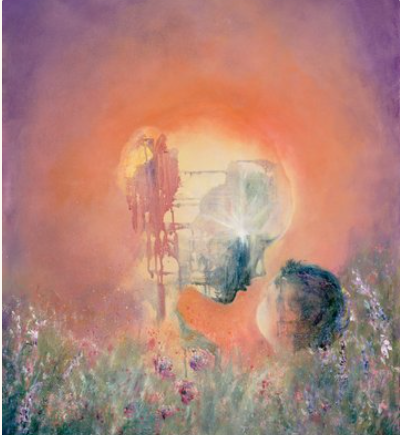
Perhaps that is what makes them so personal.
Ultimately, however, Spetner hopes viewers walk away with something larger than admiration for technique or composition.
She wants them to feel something.
Loved.
Safe.
Beautiful.
Seen.
Worthy.
The word comes up repeatedly throughout our conversation.
Worthy of beauty.
Worthy of investing in themselves.
Worthy of surrounding themselves with meaningful things.
In a world that often encourages people to diminish themselves, Spetner's work offers a different message.
One of expansion.
One of possibility.
One of belonging.
"I want people to feel worthy of beauty," she says.
Looking around her studio, it becomes clear that this is not merely an artistic philosophy.
It is a way of seeing the world.
And perhaps that is why her work resonates so deeply.
Because beneath the paint, the color, and the composition, every piece is ultimately offering the same thing:
A place to land.
Blima Nechama Spenter’s art can be found here.