
Inside Hillel Fuld's Unexpected Love Affair with Bespoke Tailoring
Written by Claire Zeitler
Most people know Hillel Fuld as a technology entrepreneur and one of Israel's most recognizable advocates online. They know the tweets, the keynote speeches, and the passionate defense of Israel that has earned him a global following.
What many people don't know is that Hillel Fuld has quietly become something of a connoisseur of bespoke tailoring.
The discovery is surprising at first. The fast-paced world of technology does not immediately bring to mind discussions about button placement, Italian fabrics, custom linings, or the proper break of a trouser. Yet after spending time speaking with Fuld about clothing, it becomes clear that the same curiosity and enthusiasm that made him successful in technology have also found their way into his wardrobe.
In fact, his love of tailoring predates his career entirely.
Growing up in New York, Fuld was always drawn to jackets and suits. While most boys viewed dressing formally as an obligation reserved for Shabbos and family occasions, he genuinely enjoyed it. There was no grand inspiration and no family tradition that pushed him in that direction. He simply liked the way a well-cut jacket looked and felt.
"I always wore blazers and suits," he recalls. "Even when I was young."
That appreciation would eventually evolve into a fascination with bespoke clothing.
Ironically, the journey began through an act of kindness rather than a desire to upgrade his wardrobe.
Years ago, a friend contacted him about one of his friends. The friend, who happened to be a tailor, was trying to build his custom clothing business and hoped Fuld might be willing to help spread the word. Fuld agreed and commissioned a double-breasted suit while promoting the business to his audience.
The response was overwhelming.
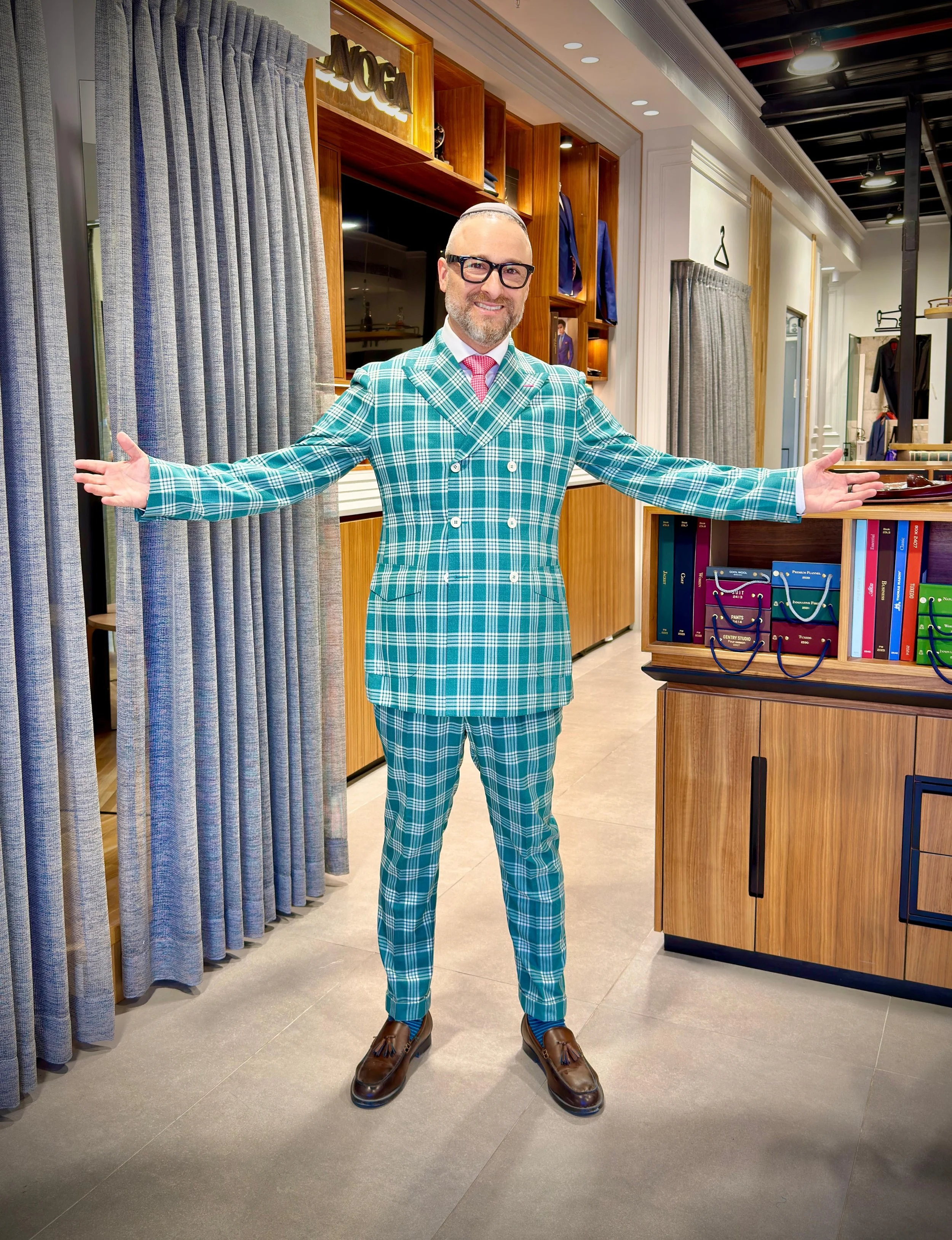
The tailor received so much business from that single post that he later offered to continue making garments for Fuld. What began as a one-time gesture quickly became an ongoing relationship, and before long Fuld had accumulated a collection of custom-made suits unlike anything he could have found off the rack.
Since then, he has worked with multiple custom tailors, both in Israel and the United States. One New York-based tailor even arranged for measurements to be taken remotely so that garments could be produced abroad and shipped directly to Israel. The process fascinated him.
Unlike purchasing a ready-made suit, commissioning a bespoke garment requires imagination. Standing in a showroom, a client is often presented with books containing thousands of fabric swatches. There are countless shades of blue, green, burgundy, grey, and brown. Patterns range from subtle herringbones and windowpanes to bold plaids and checks. Then come decisions about lapels, vents, pockets, linings, cuffs, and buttons.
"It can actually be a little overwhelming," Fuld laughs. "There are thousands of options. How do you even choose?"
Yet despite the endless fabrics and colors, one detail consistently captures his attention before anything else.
The buttons.
Most men begin with the cloth. Fuld begins with the garment's architecture.
"The button layout," he says without hesitation when asked what he notices first.
The spacing of the buttons, the height of the closure, whether a jacket is single-breasted or double-breasted—these are the details that excite him. Recently, he has become particularly fond of double-breasted jackets, especially styles with higher button placements that many modern menswear enthusiasts might consider unconventional.
For Fuld, those details transform a suit from ordinary to memorable.
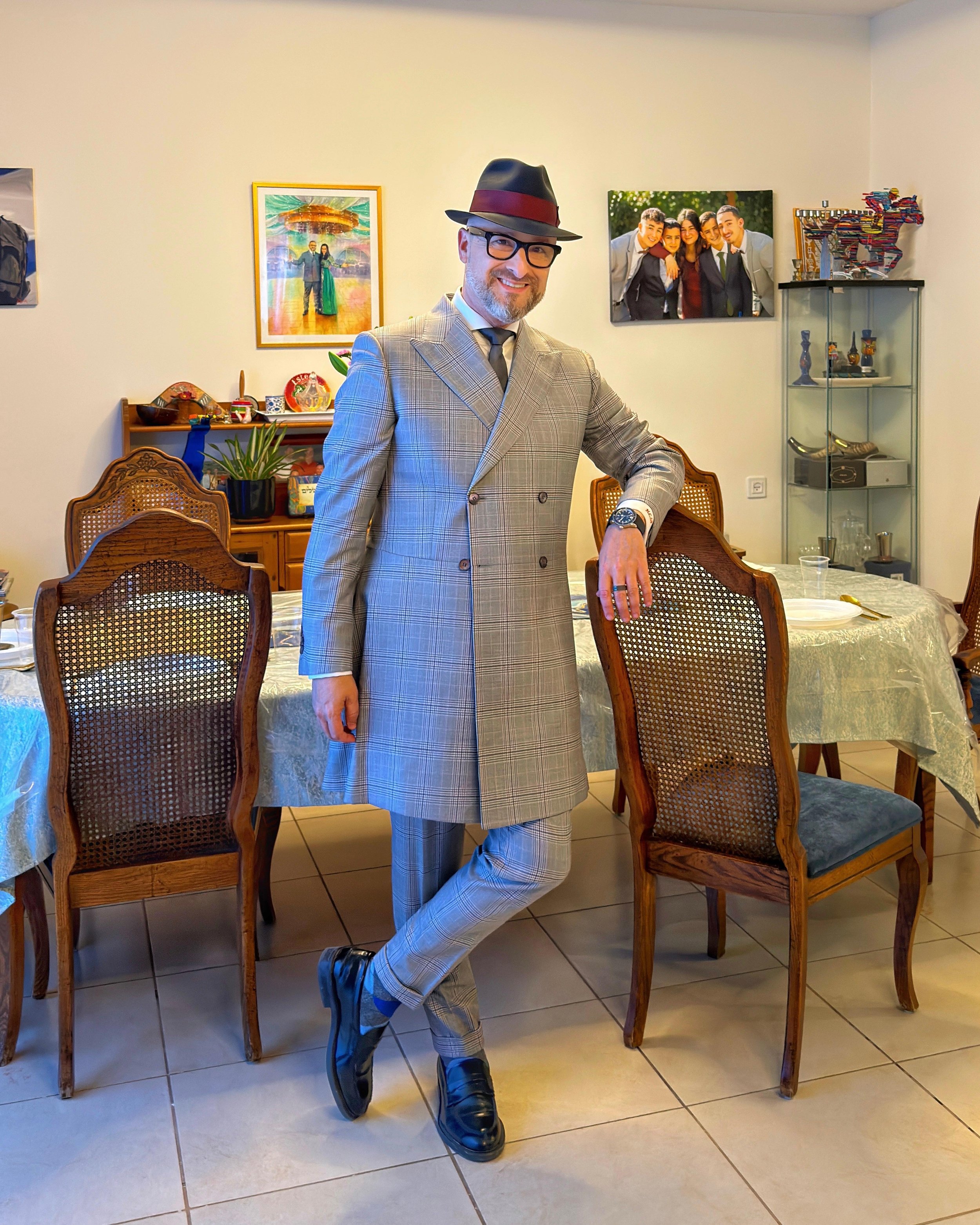
His latest tailoring adventure came through an unexpected source: a Chabad friend who suggested commissioning a custom kapata.
At first, the idea seemed absurd.
"I thought kapatas were black," he jokes.
His friend disagreed.
Soon they found themselves visiting a tailoring workshop in the Har Tuv industrial area. Hidden away from the main road, the workshop felt more like a garment factory than a traditional tailor's shop. Bolts of fabric lined the walls, swatch books covered tables, and craftsmen moved between measuring tapes and sewing machines.
There, Fuld designed what may be one of the only plaid kapatas in existence.
The same workshop later created a striking green double-breasted suit that recently generated considerable discussion online. Fabrics are sourced from Italy, while production takes place overseas before the finished garment is returned to Israel. Despite the complexity of the process, the turnaround time was only a few weeks.
What impressed Fuld most, however, was not the speed but the quality.
For years he had heard people speak about the difference between ordinary wool and premium cloth. Like many men, he assumed the distinction was largely a marketing distinction.
Then he wore a suit made from exceptionally high-end fabric.
"I never thought I'd be able to tell the difference," he admits. "But you can feel it immediately."
The experience reinforced something he has learned repeatedly through tailoring: details matter.
That philosophy extends to his advice for men who want to improve their wardrobes.
Contrary to popular belief, personal style does not require bold colors or dramatic patterns. A man can wear navy, charcoal, and black for the rest of his life and still develop a distinctive look.
The difference lies in the details.
A double-breasted jacket instead of a single-breasted one. A unique lining hidden inside the coat. Thoughtfully chosen buttons. A trouser cut that flatters the wearer. A better-fitting shoulder.
These are often the elements that separate a well-dressed man from someone who simply bought an expensive suit.
Perhaps unsurprisingly, Fuld approaches watches with the same enthusiasm.
After years of dismissing luxury timepieces as unnecessary extravagances, a friend loaned him an Omega for Shabbos. The experience changed everything.
Today he speaks about watches with the same passion he reserves for tailoring. Breitling, Rolex, Omega, and Cartier have all earned places in his growing collection and wish list. Like bespoke clothing, watches represent a blend of engineering, craftsmanship, and personal expression.
Yet despite all the discussion about fabrics, watches, and tailoring, the conversation repeatedly returns to something deeper.
Confidence.
Not arrogance.
Not attention-seeking.
Confidence.
Fuld is well aware that not everyone likes his clothing choices. Some people love the green suit. Others hate it. Some admire the plaid kapata. Others think it is outrageous.
He seems remarkably comfortable with both reactions.
"If you're going custom," he says, "go crazy."
This advice applies to more than just clothing.
Whether discussing entrepreneurship, Judaism, advocacy, or style, Fuld returns to the same principle: authenticity matters more than approval.
Personal style, after all, is simply another way of expressing who you are.
For some men, that expression may take the form of a conservative navy suit. For others, it may involve bold fabrics, unusual buttons, or a plaid kapata that turns heads across Jerusalem.
The specific garment is ultimately irrelevant.
What matters is that it feels genuinely yours.
As our conversation comes to a close, Fuld offers perhaps the simplest piece of advice of all.
"Own it."
In menswear, as in life, that may be the most important detail of all.