
The Things We Do When No One Is Watching
Parshas Ki Seitzei and the Quiet Test of Character

Some mitzvos announce themselves.
A shofar is sounded before a congregation. Shabbos candles illuminate a room. A sukkah changes the shape of a home for an entire week. Some mitzvos create memories, ceremonies, and moments that are unmistakably sacred.
And then there are the mitzvos of Parshas Ki Seitzei.
You see something someone has lost and pick it up.
You make sure the person who worked for you is paid when he is supposed to be paid.
You check that the roof railing is safe.
You refuse to take advantage of an inaccurate weight.
You realize that a sheaf was left behind in your field, and instead of going back for it, you leave it there for someone who needs it.
You stand outside the home of a debtor instead of entering and helping yourself to what you are owed.
Very little about these moments is dramatic. Often, there is no audience at all.
And perhaps that is precisely the point.
Parshas Ki Seitzei contains an extraordinary concentration of mitzvos governing the ordinary edges of human life: property, employment, agriculture, business, debt, safety, vulnerability, and dignity. Again and again, the Torah places a person in a situation where he could easily look away, delay, take a little more, care a little less, or tell himself that nobody would know.
The parsha asks a question that becomes especially powerful as Elul begins to draw us toward the Yamim Noraim:
Who are we in the hundreds of moments nobody else records?
The Mitzvah of Not Looking Away
The Torah describes a person walking along and noticing an animal or object belonging to someone else that has gone astray.
He could keep walking.
Instead, the Torah commands hashavas aveidah — the return of lost property — and concludes the passage with the striking words, “lo suchal l’his’alem”: you may not hide yourself from it; you cannot simply look away (Devarim 22:1–3).
The Rambam codifies the obligation sharply. One who sees another person's lost property and deliberately ignores it not only fails to perform the positive mitzvah of returning it, but transgresses the prohibition against ignoring it as well (Hilchos Gezeilah VaAveidah 11:1).
There is something profound in the Torah's choice of language. The problem is not merely taking what belongs to someone else. The Torah is interested in the moment before that — the temptation to pretend we never saw.
Sometimes moral failure does not begin with cruelty. It begins with his'alemus: deciding that something is not our problem.
The Gemara in Bava Metzia analyzes the limits of this obligation. There are situations in which a person may legitimately refrain from returning an object — for example, where doing so would conflict with other halachic obligations or, in certain circumstances, with the finder's dignity. But the very existence of carefully defined exceptions makes the rule clearer: ordinarily, once we have seen another person's loss, we have entered the story (Bava Metzia 30a).
The Ramban, commenting on this passage, notes how extensively Chazal derive obligations from its seemingly repetitive language: returning an object repeatedly, caring for different kinds of losses, and determining when one may or may not turn away (Ramban, Devarim 22:1).
The Torah is training the eye.
Character begins with what we allow ourselves to notice.

Character begins with what we allow ourselves to notice.
Paying What We Owe
Later, Ki Seitzei turns to the hired worker:
“On that day you shall give him his wages; the sun shall not set upon it.” (Devarim 24:15)
An employer may have every practical advantage. The work has already been performed. The worker may be embarrassed to ask. There may be no one monitoring the transaction. It would be easy to say, “Tomorrow.”
The Torah says that tomorrow may not be good enough.
The Gemara in Bava Metzia treats the obligation with remarkable severity. It describes the withholding of wages as involving a cluster of Torah prohibitions and a positive commandment, while also clarifying that not every prohibition applies simultaneously in every circumstance, since some relate specifically to daytime wages and others to nighttime wages (Bava Metzia 111a). The Rambam writes that withholding a worker's pay is compared to taking his life, because the worker has staked himself upon those earnings (Hilchos Sechirus 11:2).
It is easy to think of honesty in dramatic terms: stealing or not stealing, fraud or no fraud.
But much of financial integrity lives in smaller decisions.
Did we pay when we said we would?
Did we make someone chase us for money that was already theirs?
Did we use our greater power, knowledge, or financial comfort to make another person wait unnecessarily?
The Ramchal, in Mesillas Yesharim, warns precisely about this territory. In his discussion of nekiyus, spiritual cleanliness, he observes that monetary wrongdoing is particularly vulnerable to rationalization. People who would never describe themselves as thieves can nevertheless permit themselves small forms of taking what is not truly theirs. He even applies this to an employee's time: time that has been sold to an employer cannot casually be appropriated for oneself simply because the misuse seems minor (Mesillas Yesharim, Chapter 11).
The quiet test of character works in both directions.
The employer must not steal the worker's wages.
The worker must not steal the employer's time.
Neither standard depends upon whether anyone is checking.

Paying what is owed, when it is owed, is one of the quiet measures of integrity.
The Weight Hidden in the Bag
At the end of the parsha, the Torah forbids keeping unequal weights and measures:
“You shall not have in your pouch a weight and a weight, a large one and a small one.” (Devarim 25:13)
Notice how far the prohibition reaches.
The Torah does not merely say: Do not cheat a customer.
It tells us not to possess the fraudulent weights.
The dishonest measure sitting unused in a drawer is already spiritually dangerous because it represents a willingness to create the possibility of dishonesty. The Gemara discusses subtle manipulations of weights and measurements — ways a merchant could alter a transaction that a customer might never detect (Bava Metzia 61b).
Then the Torah does something startling. Immediately after the laws of honest weights comes the command to remember Amalek.
Midrash Tanchuma notices the juxtaposition and links dishonest measures with vulnerability to Amalek. Rashi brings the connection in his commentary to the parsha (Rashi, Devarim 25:17; Midrash Tanchuma, Ki Seitzei 8).
The point is larger than commerce.
A society does not become corrupt only through spectacular crimes. It becomes corrupt when small dishonesty becomes ordinary — when people begin living with one measure for themselves and another for everyone else.
A slightly different standard.
A carefully worded half-truth.
A charge nobody is likely to question.
A promise we technically fulfilled while violating its spirit.
The weights in our pockets may no longer be made of stone. The temptation remains remarkably recognizable.

The Torah demands one honest measure, even when dishonesty might never be discovered.
The Mitzvah Nobody Notices When It Works
Ki Seitzei also commands a homeowner who builds a new house to construct a maakeh, a protective barrier around the roof:
“You shall make a fence for your roof, and you shall not place blood in your house.” (Devarim 22:8)
It is one of the least glamorous mitzvos imaginable.
Nothing has happened.
Nobody has fallen.
There is no injured person to rescue and no crisis in which to become a hero.
The mitzvah exists precisely so that there will be no story.
The Sefer HaChinuch explains that the command extends conceptually to removing hazards and dangerous obstacles from the places in which people live. The Rambam similarly rules that dangers such as unprotected pits and other life-threatening hazards must be secured or removed (Sefer HaChinuch, Mitzvah 546; Hilchos Rotzeach U'Shemiras HaNefesh 11:4).
There is a particular kind of goodness that receives very little recognition: preventing harm before anyone realizes they needed protecting.
Putting away something dangerous.
Fixing what is loose.
Checking twice.
Thinking ahead about the person who may come after us.
Taking responsibility for a risk we did not create simply because it is now within our ability to remove it.
A functioning maakeh earns no applause. Its success is measured by what never happens.
That, too, is Torah character.

Some of the most important acts of responsibility are measured by the harm that never happens.
The Holiness of Leaving Something Behind
Then comes one of the strangest mitzvos in the Torah.
A farmer harvests his field and accidentally forgets a sheaf. Later, he realizes his mistake.
Ordinarily, realizing a mistake means going back and correcting it.
Here the Torah says:
Do not go back.
The forgotten sheaf belongs to the stranger, the orphan, and the widow (Devarim 24:19).
The Sefer HaChinuch explains that shikchah cultivates generosity in the landowner. By resisting the instinct to retrieve every last piece of produce, he develops what the Chinuch calls a “nefesh tovah” — a good and generous soul (Sefer HaChinuch, Mitzvah 592).
There is an extraordinary lesson here.
Not every good deed begins with taking action. Some begin with restraint.
We spend much of life gathering: earning, acquiring, protecting, recovering, making sure nothing is wasted.
The Torah occasionally tells us that holiness means leaving something on the field.
Not everything we could reclaim must be reclaimed.
Not every advantage must be maximized.
Not every dollar must be extracted.
Not every victory must be pursued simply because it is available.
Sometimes character is revealed by what we are willing to leave for someone else.
Rashi, citing the Sifrei, points out that the Torah promises blessing even though the farmer's original act of forgetting was completely unintentional. If a poor person benefits from the forgotten sheaf, the owner is nevertheless blessed (Rashi, Devarim 24:19).
Even our mistakes can become sources of kindness if, once we recognize what has happened, we do not rush to take everything back for ourselves.

Sometimes holiness is found not in what we gather, but in what we are willing to leave for someone else.
Stand Outside
Perhaps the most delicate image in the parsha comes in the laws of debt.
A man owes you money.
You are the creditor.
Your claim is legitimate.
And yet the Torah tells you that when collateral is required:
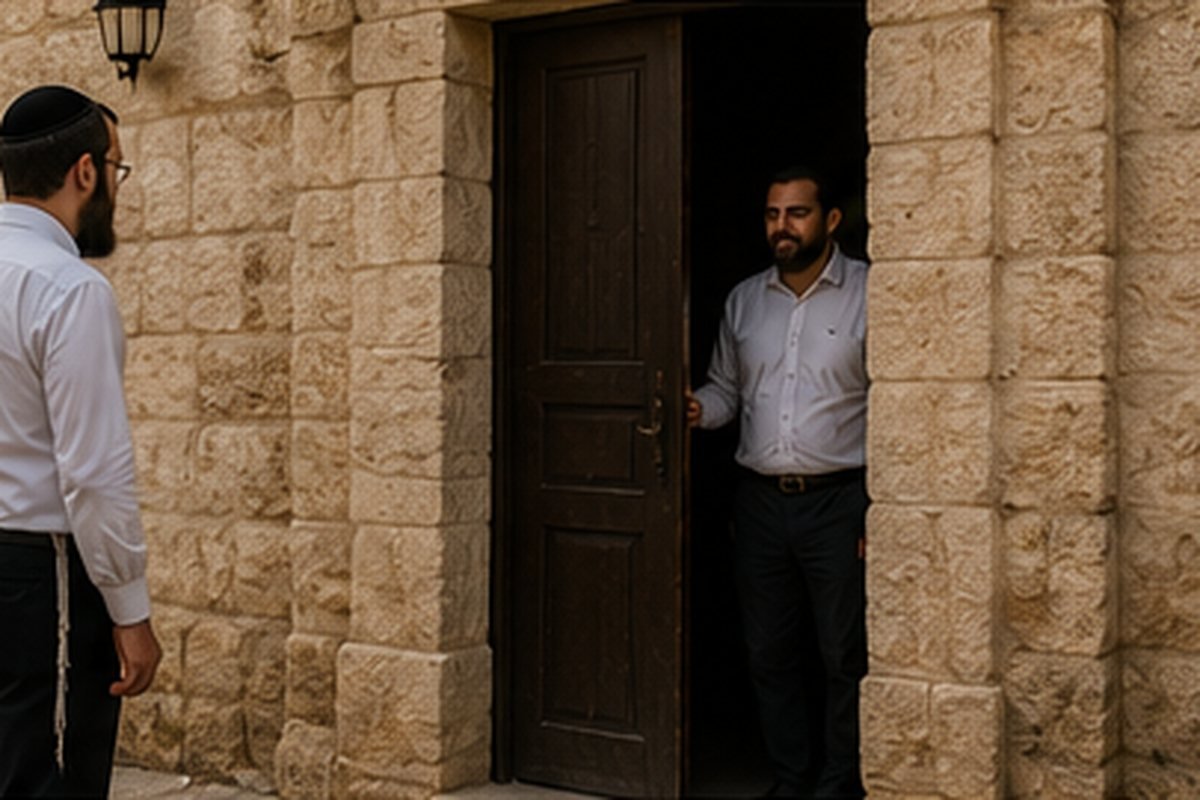
“You shall not enter his house to take his pledge. You shall stand outside.” (Devarim 24:10–11)
He owes you money, but you do not own his dignity.
The Mishnah and Gemara in Bava Metzia develop these laws in detail. The creditor cannot simply enter the debtor's private space and seize what he chooses; even the collection of a legitimate debt is bounded by rules designed to limit intrusion and protect what the debtor still needs for ordinary life (Bava Metzia 113a-113b).
This is one of the Torah's most refined moral demands.
It is comparatively easy to treat people respectfully when we need something from them.
The deeper test comes when we are right.
When someone owes us.
When another person has made a mistake.
When we possess the stronger legal, financial, professional, or social position.
Ki Seitzei insists that power does not cancel dignity.
Chazal's broader principle is kavod habriyos, human dignity. The Gemara in Berachos discusses its significant halachic weight and the seriousness with which Chazal regarded the preservation of human dignity, while also carefully defining the limits of that principle (Berachos 19b).
The Torah does not merely ask whether we got what we were entitled to.
It asks what happened to the other person's humanity while we were getting it.
A legitimate claim does not give us ownership over another person’s dignity.
Elul and the Person We Have Quietly Become
All of this brings us naturally to Elul.
Rabban Yochanan ben Zakkai once gave his students what initially sounded like a surprisingly modest blessing: that their fear of Heaven should become as real to them as their fear of human beings.
His students were puzzled.
Only as much as the fear of other people?
He answered that this itself would be an enormous achievement, because when a person considers doing something wrong, one of his first thoughts is often simply: I hope nobody sees me (Berachos 28b).
That may be one of the most uncomfortable and useful teachings with which to enter Elul.
The Yamim Noraim are not only an accounting of the dramatic moments of the year. They are an accounting of the unobserved ones.
The message we chose not to answer because answering would require admitting we were wrong.
The money we owed but did not hurry to send.
The object we noticed and stepped around.
The small safety problem we assumed someone else would handle.
The extra advantage we took because the other person would never know.
The private joke at someone else's expense.
The way we spoke to someone who could not retaliate.
The kindness we could have done without anyone ever hearing about it.
These moments rarely make it into the story we tell about ourselves.
But repeated often enough, they become the story.
Hillel teaches in Pirkei Avos, “B'makom she'ein anashim, hishtadel lihyos ish” — in a place where there are no people, strive to be a person of stature (Avos 2:5). Rabbeinu Yonah explains one dimension of the teaching as referring to a situation in which there is no one else present to strengthen or correct us: we must straighten ourselves and choose what is good in the eyes of Hashem (Rabbeinu Yonah on Pirkei Avos 2:5).
That is the quiet avodah of Elul.
Not merely asking, What terrible thing have I done?
But asking:
How honest am I when dishonesty would be easy?
How careful am I when carelessness would probably have no consequence?
How generous am I when I could reasonably keep everything?
How do I treat someone when I hold all the power?
What do I notice?
What do I ignore?
What standards do I keep when nobody around me would know the difference?
And perhaps most importantly:
What kind of person have all those small decisions been turning me into?

Elul asks not only what we have done, but who we have become when no one is watching.
Parshas Ki Seitzei reminds us that a Jewish life is not constructed only from its great moments.
It is built from returned objects and paid invoices. From secure railings and honest measurements. From things left behind for another person. From doors we refuse to cross even when we possess the power to cross them.
An intact railing produces no story.
A worker paid on time may never know that paying him required effort.
A lost object returned anonymously becomes ordinary property again.
A debtor whose dignity was protected may never know how easily it could have been otherwise.
No one applauds. No one posts about it. No one may even notice. But these are the moments in which a person quietly decides who he is.
And as Elul advances toward Rosh Hashanah, perhaps that is one of the most searching forms of cheshbon hanefesh we can make:
Not only, What have I done this year?
But Who am I when no one is watching?